
Iran's Restricted Zone Now Covers the Gulf of Oman Bypass
Summary
On September 9, 2026 Iran extended its restricted zone past Hormuz into the Gulf of Oman, the water carrying at least 20 ship-to-ship oil transfers a day.
On September 9, 2026, Iran's Islamic Revolutionary Guard Corps said its restricted-access zone now extends past the Strait of Hormuz into parts of the Gulf of Oman and the Arabian Sea, and named the denial of strait-related services and insurance as the enforcement mechanism [1]. That water is where the Gulf's shipping bypass operates, so the ship-to-ship relay that has been moving oil around the strait may now be constrained.
IRGC spokesman Brig. Gen. Hossein Mohebbi said "the area under consideration has now been expanded," and that a vessel needing services related to the Strait of Hormuz, insurance or other services will not be able to obtain them; exact coordinates are to be announced later [1]. The same day, UK Maritime Trade Operations reported that vessels in the Gulf of Oman and the Persian Gulf were subject to disabling fire [2], and Brent crude rose above $100 a barrel [3].
Background: the bypass outside the Strait of Hormuz
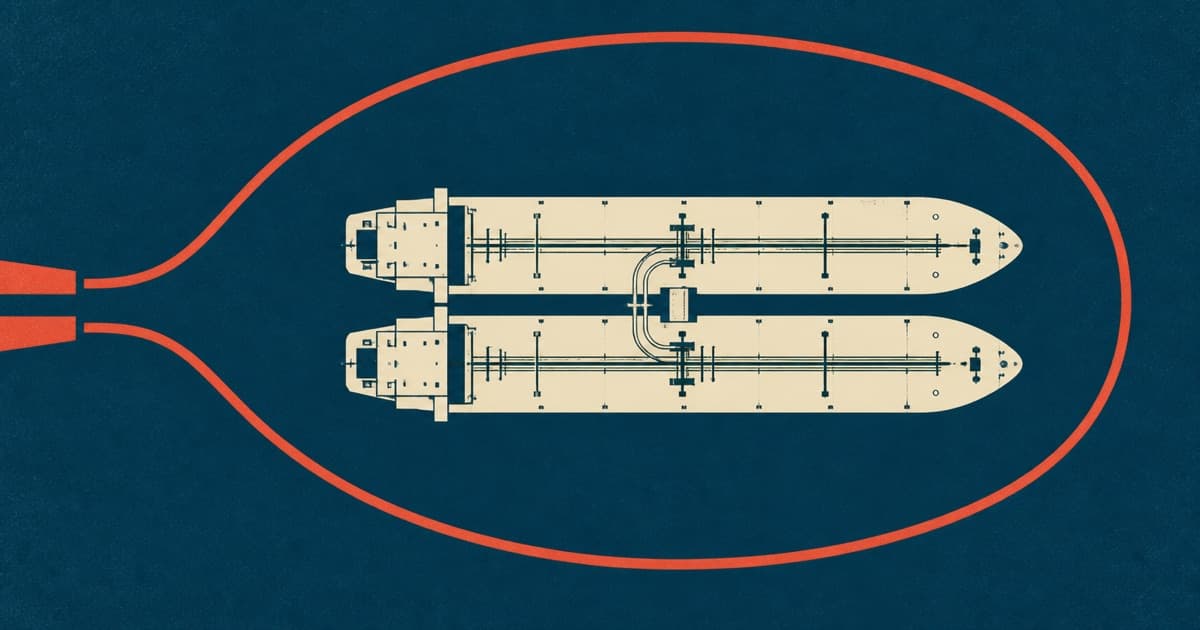
The Strait of Hormuz is the Gulf's only sea outlet. Since the conflict began, transits through the strait have fallen, and shippers have instead sailed to the Gulf of Oman outside the strait to complete ship-to-ship transfers: one vessel discharges into another, which carries the cargo onward. Ship-tracking data shows at least 20 such transfers a day in the Gulf of Oman [4].
The UAE also pipes crude to the Fujairah terminal on the Gulf of Oman side for loading [5]. Goldman Sachs estimated in August that Gulf crude exports run 15-16 million barrels per day while Strait of Hormuz transits are only 7-8 million b/d [6]; the gap moves through these two workarounds.
Buyers are already paying for the detour. Kuwait Petroleum Corp offers buyers the option of ship-to-ship transfers outside the strait, and its August and September tenders priced naphtha delivered ex-ship at premiums of up to $60 per tonne [7]. War-risk underwriting boundaries had also been drawn at the strait.
Transmission: what changes when the relay water joins the same regime
The enforcement is denial of insurance and services rather than gunfire [1], which turns a previously free workaround into a second tolled chokepoint, and the water it covers is exactly where the transfer anchorages and Fujairah sit [4][5].
That bypass carries the 5-8 million b/d gap [6], the marginal supply that has been capping crude prices. TotalEnergies CEO Patrick Pouyanne said in August that shipping oil through the Strait of Hormuz costs about $20 million per supertanker and nearly $10 per barrel of extra freight [8]; tolling the relay leg adds to that delivered cost.
Because insurance is the lever, the war-risk boundary moves outward onto the UAE east coast, Oman and the Arabian Sea, the same countries where specialty underwriters have already taken the largest losses of this conflict [9].
The cost lands last on the Asian refiners and naphtha crackers at the end of the delivered-ex-ship chain, which are already cutting runs: China's crude processing fell 17.7% and 15.8% year-on-year in June and July [10], and Wood Mackenzie estimates a further 1.4 million b/d of global run cuts in Q4 [11]. In the other direction, North American gas-based crackers and Chinese coal-route chemical producers, whose feedstock never crosses that water, widen their spread against the naphtha route.
Companies that may be affected
Mitsui Chemicals (4183.T) is a Japanese chemical producer whose Basic and Green Materials segment is 36.0% of FY3/2026 revenue of JPY 1,668.75 billion and runs on imported naphtha [12]. The Kuwaiti premium of up to $60 per tonne is delivered precisely by ship-to-ship transfer outside the strait [7]. A tolled relay could push that premium higher, landing in feedstock cost and segment profit; group operating income was JPY 73.809 billion in the same year [12]. It may face pressure, depending on whether transfer volumes actually fall.
Sinopec Shanghai Petrochemical (600688.SH) is a coastal refining and chemical subsidiary of Sinopec. Refined products and chemicals together are 90.6% of FY2025 revenue of CNY 75.563 billion, all feedstock arrives by sea, and the site has no alternative supply route [12]. FY2025 operating income was already a loss of CNY 1.426 billion [12], so a further rise in delivered feedstock cost has no buffer. It may face pressure, depending on how much can be passed through in product pricing.
International General Insurance (IGIC) underwrites energy, property and political violence lines. Insurance is the enforcement mechanism Iran named [1], and IGI's war-related net losses in the first half of 2026 were about $39 million, the largest single net loss event in its nearly 25-year history, concentrated in the UAE, Saudi Arabia, Bahrain and Oman. Those losses added 16.5 points to the combined ratio, and first-half net income fell to $42.5 million from $61.4 million [9]. A boundary that moves outward means the same book covers wider water, so it may face continued pressure.
Westlake (WLK) is a US chemical producer whose Performance and Essential Materials segment is 62.9% of FY2025 revenue of $11.17 billion [12]. Its polymers and PVC are priced off the marginal naphtha-based producer, while management says 85% of that segment's capacity is in North America and runs on low-cost natural gas and NGLs that were "largely immune" to the oil price spike [13]. The spread already showed up in the second quarter: non-GAAP net income of $260 million against a $12 million net loss a year earlier [13]. It may benefit, depending on whether higher oil prices also suppress downstream demand.
Hualu-Hengsheng (600426.SH) is a Chinese coal-chemical producer; fertilizers, acetic acid and derivatives, and organic amines together are 40.5% of revenue [12]. It runs on domestic coal and competes directly with gas-based Gulf exports whose only route to water is now tolled. Chinese methanol, PVC and ethylene glycol futures hit limit-up on August 31 [14], and Gulf fertilizer exports were already constrained [15]. It may benefit, but this is the weakest attribution here: the link runs through commodity prices rather than a named counterparty.
How to verify this
The fastest read is ship tracking. The baseline is at least 20 transfers a day in the Gulf of Oman [4]; a fall to single digits within two weeks would show the toll bites. Watch Fujairah loadings as well [5] - if they fall too, the bypass is gone rather than displaced. On the insurance leg, watch war-risk quotes for the Gulf of Oman and the Arabian Sea [9].
The scheduled reads are both in early November: IGI's third quarter, for whether war losses continue [9], and Westlake's third quarter, for whether the segment's EBITDA holds [13].
The chain would be broken if Iran and Oman conclude the safe maritime corridor talks that were "in their final stage" on September 6 and the deal covers Gulf of Oman anchorages [16]; if the published coordinates exclude Fujairah and the main transfer anchorages; or if transfer counts and Gulf exports simply hold. It would also be wrong if that gap volume moves by pipeline rather than by ship-to-ship relay, in which case restricting this water changes little.