
Civil Infrastructure Supply Chains See Data Center Contribution Nearly Double
Summary
Core & Main says data-center contribution nearly doubled, while Sunbelt puts data centers at 13% of its megaproject pipeline, extending AI spending into civil infrastructure.
On September 9, 2026, Core & Main (CNM) and Ashtead Group's Sunbelt Rentals (SUNB) said on earnings calls that data-center construction is increasing demand for underground water systems, fire protection and specialty rental equipment. Core & Main's data-center contribution nearly doubled year over year, while Sunbelt said data centers represent 13% of its megaproject opportunity set.[1][2]
Civil and equipment demand arrives before the servers
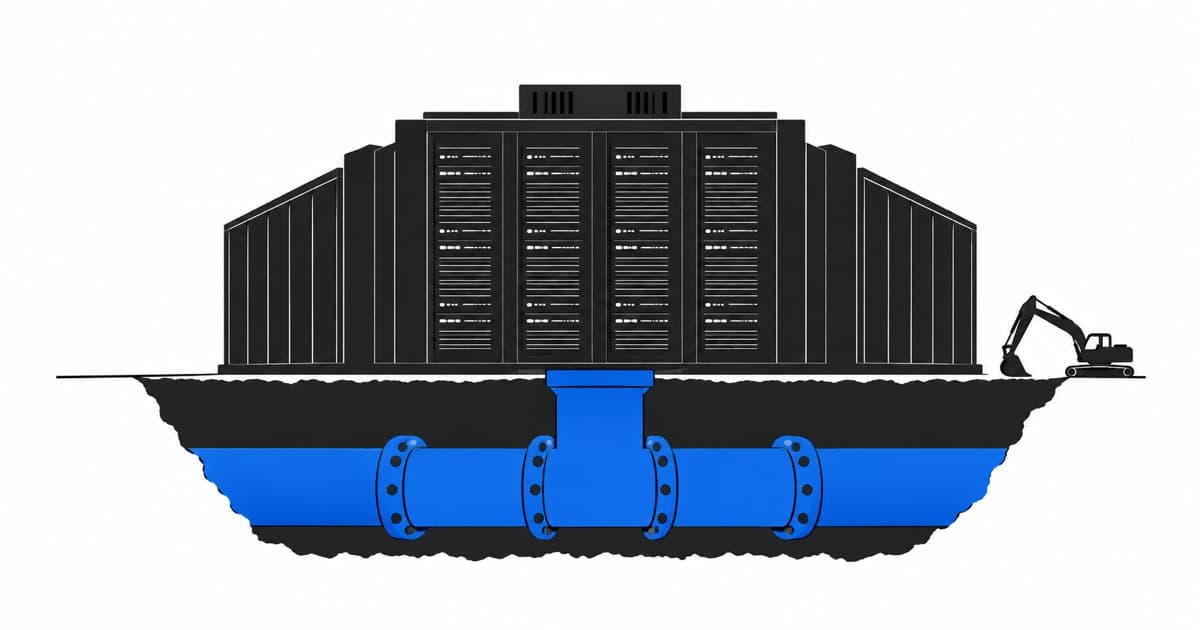
A large data-center campus requires phased site clearing, underground utility installation, and water, wastewater, storm-drainage and fire-protection systems before mechanical systems and servers are installed. Core & Main distributes water-infrastructure products. Sunbelt rents earthmoving, access and specialty equipment to contractors. When developers build several campuses, contractors can rent equipment for peak phases instead of owning a complete fleet for every project.
The transmission does not depend on a single cooling design. Core & Main explained that closed-loop cooling uses more electricity for refrigeration while evaporative cooling uses more water, but both require substantial municipal water and underground infrastructure.[1] AI capital spending can therefore become demand for pipe, valves, drainage, fire protection and rental fleet before it reaches the server hall.
Both companies see the demand in operating data
Core & Main said data centers had grown from a low-single-digit to a mid-single-digit share of total sales and represented a high-single-digit share of nonresidential work. Data-center contribution nearly doubled year over year, while Treatment Plant Solutions and Fire Protection sales rose 14%.[1] The figures show that demand has entered distribution revenue, but data centers remain only part of the business and do not explain all water-infrastructure growth.
Sunbelt provided independent confirmation from the equipment layer. Data centers represent 13% of its megaproject opportunity set, compared with 3% for semiconductors. Across the full megaproject funnel, 80% of projects are upcoming or active over an approximately three-year horizon.[2] The company also raised net rental capital-expenditure guidance to $2.4 billion to $2.8 billion, citing specialty, megaproject and energy demand above its original expectations.[2]
“Data centers have grown from low to mid-single digits of total sales and high single digits of nonresidential work.”
Project conversion and construction capacity are the control points
As a campus moves from planning into construction, orders can pass through site work, underground systems, product distribution and equipment rental. Relevant measures for distributors include data-center sales, fire-protection and treatment-product growth, and inventory replenishment. For rental companies, they include specialty utilization, fleet capital spending and actual megaproject starts. Sterling Infrastructure previously said mission-critical work represented more than 92% of its E-Infrastructure signed backlog, showing that site and electrical construction already carry direct work from this buildout.[3]
Permitting is the main boundary. At least 75 U.S. data-center projects valued at about $130 billion were reported blocked or delayed in early 2026, as local concerns about electricity and water costs threatened schedules and cancellations.[4] Data centers also represent only 13% of Sunbelt's megaproject opportunity set and a mid-single-digit share of Core & Main's total sales. The evidence supports spreading civil-infrastructure demand, not a claim that either company has become a pure data-center business.
Companies exposed to the change
- United Rentals (URI): United Rentals also supplies specialty equipment to large projects. Its second-quarter disclosure connected large projects with nearly 13% rental growth and 25% Specialty growth, exposing it to the same construction mechanism, although it did not disclose separate data-center revenue.[5]
- Sterling Infrastructure (STRL): Sterling performs data-center site and electrical work that turns campus plans into demand for underground systems and equipment. Its concentrated signed backlog also leaves construction timing exposed to project delays.[3]
- Mueller Water Products (MWA): Mueller makes valves and fire hydrants that distributors may replenish as data-center water and fire-protection packages expand, but the frozen evidence does not provide company-disclosed data-center revenue.
Sources
[1] Drillr · Core & Main (CNM) · 2026-09-09 · Fiscal Q2 2027 earnings call
[2] Drillr · Ashtead Group / Sunbelt Rentals (SUNB) · 2026-09-09 · Fiscal Q1 2027 earnings call
[3] Drillr · Sterling Infrastructure (STRL) · 2026-08-04 · Q2 2026 earnings call
[4] Tom's Hardware · Report on delayed U.S. data-center projects · 2026-06-13 · News · https://www.tomshardware.com/tech-industry/artificial-intelligence/more-than-75-data-center-build-outs-worth-usd130-billion-have-been-successfully-blocked-in-the-first-four-months-of-2026-bipartisan-opposition-mounts-nationwide-over-fears-of-soaring-power-and-water-costs
[5] Drillr · United Rentals (URI) · 2026-07-23 · Q2 2026 earnings call
This material identifies potentially overlooked industry changes and companies. It is not an investment recommendation.